- All
- Product Name
- Product Keyword
- Product Model
- Product Summary
- Product Description
- Multi Field Search

 English
 Author: Site Editor Publish Time: 02-25-2026 Origin: Site
Electronic packaging directly affects the reliability of industrial electronics under heat, vibration, and continuous operation. In demanding environments such as automation, robotics, energy, transportation, and heavy machinery, the right package ensures stable signal performance, efficient heat dissipation, and mechanical durability, while poor selection can result in thermal issues, solder fatigue, and reduced system lifespan.
The Dual In-Line Package (DIP) is one of the earliest standardized electronic component package formats used for integrated circuits. It features a rectangular plastic or ceramic body with two parallel rows of metal pins extending downward. These pins are inserted into pre-drilled holes on a PCB and soldered on the opposite side, providing secure mechanical and electrical connections.
Pin counts typically range from 8 to 64. Ceramic versions are used in high-reliability or high-temperature applications.
Although surface-mount packages dominate modern consumer electronics, DIP remains important in industrial systems for the following reasons:
Robust mechanical anchoring
Easy inspection and manual soldering
Socket compatibility for replaceable modules
Programmable logic controllers, legacy industrial controllers, and serviceable field equipment often use DIP components. In harsh environments, the stronger through-hole solder joints provide superior resistance to vibration compared to some surface-mount alternatives.
Pros | Cons |
High mechanical strength | Large PCB footprint |
Simple assembly and repair | Limited electrical performance at high frequencies |
Ideal for prototyping and small production runs | Lower pin density |
SOIC is a surface-mount package derived from DIP. It has gull-wing leads on two sides and occupies significantly less board space. Lead pitch is smaller, allowing greater integration density.
SOIC packages are widely used in:
Analog front-end circuits
Industrial communication transceivers
Low-power microcontrollers
Signal conditioning modules
They provide a practical balance between size reduction and manufacturability.
Pros | Cons |
Reduced footprint compared to DIP | Less mechanically secure than through-hole |
Suitable for automated reflow soldering | Limited scalability for very high pin counts |
Moderate thermal dissipation |
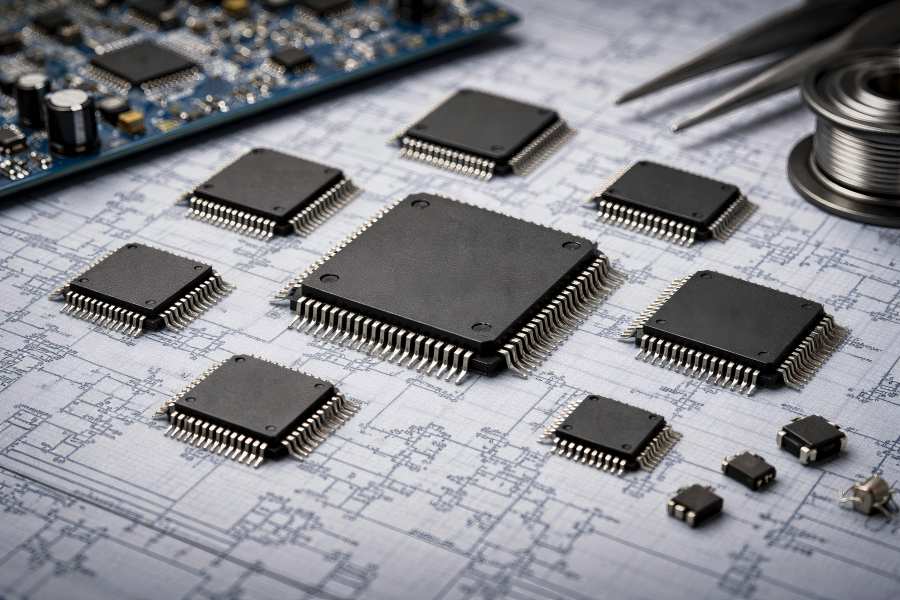
Thin QFP and Low Profile QFP are two variations. Because they can have more than 200 pins, they are appropriate for sophisticated ICs.
QFP is frequently used in:
Industrial microcontrollers
Embedded processing systems
FPGA-based control boards
Communication processors
The four-sided lead configuration allows high I/O density while maintaining inspectable solder joints.
Pros | Cons |
High pin count | Fine pitch increases PCB manufacturing demands |
Easier visual inspection than BGA | Leads are vulnerable to mechanical bending |
Adequate for automated assembly |
Peripheral leads are replaced with an array of solder balls beneath the package body in BGA packages. This arrangement enables very high connection density and shorter signal paths.
BGA is common in:
Industrial computers
High-performance embedded systems
Image processing modules
Edge computing platforms
Pros | Cons |
Excellent signal integrity | Requires X-ray inspection |
Superior thermal performance | Difficult rework |
High I/O capacity | Higher assembly cost |
QFN Thin QFP and Low Profile QFP are two variations. Because they can have more than 200 pins, they are appropriate for sophisticated ICs.
Common in:
Motor driver ICs
Power management systems
RF communication modules
Industrial sensors
Pros | Cons |
Compact footprint | Hidden solder joints |
Low parasitic inductance | Limited manual rework capability |
Efficient thermal dissipation |
The semiconductor die is almost the same size as the CSP packages. Wafer-level CSP is made directly on the wafer prior to singulation.
Miniaturized sensor modules
Industrial IoT devices
Portable measurement instruments
Compact wireless nodes
Pros | Cons |
Minimal footprint | Lower mechanical strength |
Low electrical parasitics | More demanding PCB design |
Lightweight |
PGA features a grid of pins on the underside and is often used with sockets. It supports very high pin counts and modular installation.
Modular industrial computing systems
Replaceable processor units
High-reliability computing platforms
Pros | Cons |
Excellent serviceability | Large size |
High I/O capacity | Higher mechanical complexity |
Good thermal conduction |
TO-220 and TO-247 are through-hole packages used for discrete power devices. They include a metal tab for heat sink mounting.
Motor drives
Industrial inverters
Power supplies
High-current regulators
Pros | Cons |
Outstanding heat dissipation | Large footprint |
Strong mechanical attachment | Not suitable for compact designs |
Easy heat sink integration |
LLP is similar to QFN but optimized for improved electrical and thermal characteristics using a leadframe-based design.
Analog ICs
Signal processing circuits
Compact control boards
Pros | Cons |
Efficient heat transfer | Inspection complexity |
High-frequency performance | Limited repairability |
Suitable for automated production |
MCM integrates multiple semiconductor dies into one package. Dies may be placed side-by-side or stacked.
Advanced motor controllers
High-density power modules
Industrial computing subsystems
Pros | Cons |
Reduced board space | Complex thermal management |
Improved signal integrity | Higher cost |
System integration benefits |
Package | Mounting | Pin Density | Electrical Performance | Mechanical Strength | Inspection Ease |
DIP | Through-hole | Low | Moderate | High | High |
SOIC | Surface | Medium | Moderate | Moderate | High |
QFP | Surface | High | High | Moderate | Moderate |
BGA | Surface | Very High | Very High | Moderate | Low |
QFN | Surface | High | High | Moderate | Low |
CSP | Surface | Medium | High | Low | Low |
PGA | Through-hole/socket | Very High | High | High | High |
TO-220 | Through-hole | Low | Moderate | Very High | High |
LLP | Surface | High | High | Moderate | Low |
MCM | Surface | Very High | Very High | Moderate | Low |
Industrial electronics often operate continuously, generating significant heat. Package selection strongly influences thermal resistance.
Thermal Path Considerations
Direct heat sink attachment
Exposed thermal pads
PCB copper planes
Thermal vias
Power packages such as TO-220 and TO-247 provide direct heat sink mounting, while QFN and BGA rely on PCB-level heat spreading.
Package | Heat Sink Mounting | Exposed Pad | Typical Power Handling |
DIP | No | No | Low |
SOIC | No | No | Low |
QFP | Limited | No | Moderate |
BGA | PCB-based | Yes | High |
QFN | PCB-based | Yes | High |
TO-220 | Yes | Metal tab | Very High |
MCM | Internal heat spreader | Yes | High |
Industrial electronics face:
Vibration
Shock
Moisture
Chemical exposure
Extreme temperatures
Through-hole packages often provide superior vibration resistance. Ceramic versions offer enhanced temperature tolerance.
Moisture sensitivity levels must also be considered during storage and assembly.
Industrial products may remain in service for decades. Engineers must evaluate:
Long-term component availability
Obsolescence risk
Assembly infrastructure
Inspection capability
Surface-mount packages improve automation efficiency, while through-hole packages simplify maintenance.
Application | Recommended Package Types |
PLC Controllers | DIP, QFP |
Industrial PCs | BGA, PGA |
Motor Drives | TO-220, QFN |
IoT Sensors | CSP, QFN |
Power Converters | TO-247, MCM |
Communication Modules | QFP, BGA |